

Celery
Celery: Sowing, planting and harvest calendar
Cultivated celery belongs to Apium graveolens, in the carrot family, Apiaceae. Several groups have been selected for different parts: stalk celery, celeriac and leaf celery valued for its foliage. These are generally biennial plants used in the vegetable garden during their vegetative stage. Lovage, sometimes called perennial celery, belongs to another species, Levisticum officinale. It is not a perennial variety of this celery.
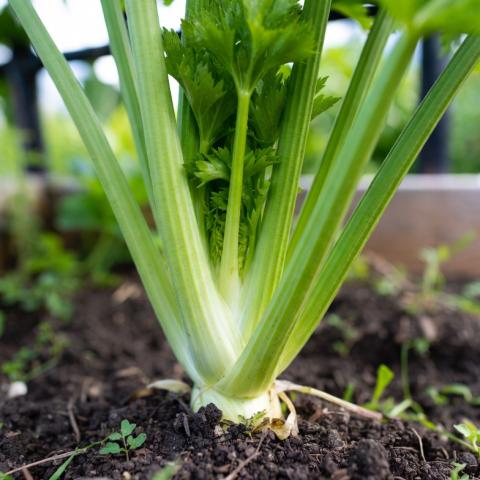
The green leaves are divided, with toothed segments. In stalk celery, the long crisp parts often called stems are leaf stalks, or petioles, joining the leaf blades to the stem. They are thickened, ribbed and somewhat channelled. Their colour varies from strong green to paler shades depending on variety. Leaf celery has finer stalks and a mass of aromatic foliage. This distinction reflects which part has been emphasised by selection.
Celeriac has a rounded, swollen base with a knobbly surface marked by the origins of roots. The edible part is not simply one large root: it includes a thickened stem base. Beneath the rough outer surface, the flesh is pale and firm, with the characteristic celery aroma. This structure gives it different kitchen uses from the juicy stalks of stalk celery, while both remain cultivated forms of the same species.
When the plant enters its reproductive stage, it develops branching stems carrying small greenish white flowers in umbels. The rays resemble the spokes of an umbrella. The dry fruits are small and aromatic; those sold as celery seed are used as a spice. Flowering therefore changes the outline of the initial rosette considerably, along with the parts present on the plant. The reproductive stage is distinct from the leafy crop familiar in kitchens.
You encounter celery stalks raw in salads or cooked in soups and stews. Celeriac appears in grated salads, purées, gratins and roasted dishes. Leaf celery is used mainly as a seasoning. These uses highlight texture and aroma. Celery is associated with moisture-retaining ground and a fairly long growing season, with forms whose size and valued organs remain clearly different.
Celery
- Type : Vegetables
- Subtype : Leafy vegetables
- Botanical Family : Apiaceae (umbelliferae)
Characteristics
- Lifecycle : Annual
- Exposure : Full Sun
- Frost Hardiness : Slightly Frost Sensitive
- Cultivation Difficulty : Medium
- Mature height : 50 cm
Sowing & Planting
- Greenhouse Growing : Not Required
- Sowing Depth : 0.5 cm
- Plant Spacing : 25 cm
- Row Spacing : 30 cm
Maintenance
- Maintenance : Moderate
- Water Requirements : Moderate
Other characteristics
- Soil Type : Humus-rich
- Soil pH Preference : Neutral
- Pest Sensitivity : Moderate
- Disease Sensitivity : Moderate
- Weed Sensitivity : Moderate
- Pollination : Insect-pollinated
- Propagation : Sowing